
'If this region destabilises, then we are not far away. This region should not destabilise.'

'Only four or five original companies remain; the rest have been replaced every decade as sectors evolve or leadership shifts.' 'Companies that fail to adapt -- like many textile mills from the 1970s and shipping firms from the 1980s -- disappear.' 'Benchmark indices reward those who reinvent themselves in line with economic demands.'

Is the parabolic rise in silver running out of steam or just getting started? Ramalingam Kalirajan offers his take on if you should invest in silver now?

Trade deals ease risks for Indian equities, but weak demand and stretched valuations raise questions over whether optimism -- especially in smallcaps -- can turn into a sustained bull run, points out Debashis Basu.
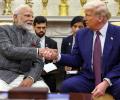
The new US national security strategy signals a retreat from global dominance while reaffirming continuity in India's role in Indo-Pacific security and Quad cooperation, points out former foreign secretary Shyam Saran.

The US government, under President Trump, justifies the intervention as a security necessity rather than a resource grab. The primary official reasons include: narco-terrorism charges, national security and migration crisis.

Global financial markets are wrong in hoping that the worst is over in geopolitical crises such as the Iran-Israel conflict and the Russia-Ukraine war, wrote Christopher Wood, global head of equity strategy at Jefferies, in a recent note to investors called 'GREED & fear'. While most investors and the media are focused on United States (US) Federal Reserve policy and the "endless chatter" of Fed governors, Wood believes the news flow in the financial sphere "pales into complete insignificance" compared with the "tectonic shifts" going on in geopolitics.

There are vexing questions around the disconnect between Nifty returns and portfolio returns, between economic growth and earnings growth, and finally, between earnings growth and market returns, points out Debashis Basu.

Years of repression and disappearances have taught Venezuelans, the hard way, not to voice either their anger or their joy, observes Radha Roy Biswas who spent her formative years in Venezuela.

Amid US-China trade tensions and economic vulnerabilities, India must seize the 'China +1' opportunity, deepen reforms, secure FTAs, and globalise its firms for long-term growth, suggests Ajay Shah.

'What we need to watch is how Saudi Arabia's financial assistance will be used by Pakistan. If the funds go to build their military hardware and operations, it should worry us.'

While Air India cancelled six international flights due to aviation regulator DGCA subjecting its Dreamliner fleet to enhanced checks, the Ahmedabad-London Gatwick one was cancelled due to unavailability of aircraft, the airline said.

Breakthroughs in Artificial Intelligence and allied deep technologies are boosting productivity, efficiency and human potential to unimaginable levels, Reliance Industries chairman Mukesh Ambani said on Friday describing the "miraculous power" of AI as new 'kamdhenu', the divine wish-fulfilling cow.
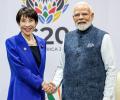
If they act now, they can reshape the strategic map of Asia without firing a shot. If they wait, the next opportunity will come only after a serious Taiwan Strait incident -- by which time the price will be far higher, and the room for boldness far smaller -- the opportunity may well be lost by then. The question is no longer whether this can or should be done, points out Varun Arya.
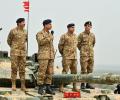
'Can a nuclear-armed nation sustain itself indefinitely under overt military rule without catastrophic consequences for itself and the region? History suggests otherwise.'
Foreign investors turned net sellers in October, withdrawing shares worth Rs 58,711 crore in the month so far owing to escalating conflict between Israel and Iran, a sharp rise in crude oil prices, and the strong performance of the Chinese market. The outflow came following a nine-month high investment of Rs 57,724 crore in September. Since June, Foreign Portfolio Investors (FPIs) have consistently bought equities, after withdrawing Rs 34,252 crore in April-May.

'An asset must generate income. Equities yield dividends, bonds pay coupons, deposits give interest, and real estate earns rent.' 'Gold, silver, and even Bitcoin produce no income, they merely store value. So, they should not be compared to productive assets.'

Global head of equity strategy at Jefferies, Christopher Wood, has cut his exposure to Indian equities by one percentage point in the Asia-Pacific ex-Japan relative-return portfolio, and Australia and Malaysia by half a percentage point each in favour of China, which has seen a hike in exposure by two percentage points. The rally in China has been fast-forwarded by the approach of a seven-day holiday with the CSI 300 Index up 8.5 per cent on Monday, and 25.1 per cent in five trading days, he said.

What appeared to be a generous act of friendship was, in truth, a manoeuvre within a much larger strategic game. The United States used the 1962 war not just to aid India but to test how far it could be pulled into the Western fold, points out Dr Kumar.

Tehran's dull treatment of a dry premise never makes us feel the complexity of the ongoing Middle East crisis nor the patriotic fervour in John Abraham's voice, notes Sukanya Verma.

'You are a guest in the US. It's not your home, you're a guest. If they don't feel comfortable, you have to step out.'
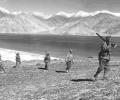
As India and China continue to face off across the Himalayas six decades later, the echoes of that earlier conflict remain unmistakable. The core of China's sensitivity lies not in maps or mountain passes, but in its perception of sovereignty over Tibet, points out Dr Kumar.

France today increasingly resembles the Italy of the past, when governments fell with bewildering regularity, prime ministers came and went in rapid succession, and political instability became the norm rather than the exception, point out Krishnan Srinivasan and Manoj Mohanka.
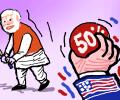
'Things may get much worse before they get better,' predicts Ajay Chhibber.
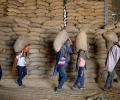
Domestic exporters on Monday expressed concerns over the crisis in Bangladesh and said the developments in the neighbouring country would have implications on bilateral trade. However, exporters expect that the situation may normalise soon. According to exporters, they are already facing disruptions in exports to Bangladesh due to a shortage of foreign exchange in that country.
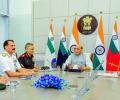
'Looking at how quickly the hostilities were escalating, the nuclear threshold did not seem that far.'

'There are times when India should stand up without hesitation and voice its indignation over the US' pressure tactic. This is one such moment,' asserts Ambassador M K Bhadrakumar.

'The US slump could hit our hosiery market hard since 40 per cent of our exports go there.' 'Job losses could be severe if the government doesn't step in fast.'

You can't be the second-most expensive market in the world and deliver just 10 per cent EPS growth, points out Akash Prakash.
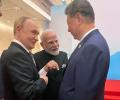
'One Chinese interlocutor said India should realise that "China can do without India, but India could not do without China", pointing to its inability to do without Chinese intermediates and components,' former foreign secretary Shyam Saran discovers on a visit to China.
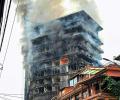
'This escalation was definitely not part of Gen Z's plan. It seems now that these external forces were keenly observing the initial developments from the sidelines and jumped into the fray, taking advantage of the situation, finding that the time was suitable for such acts'
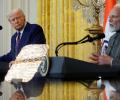
The deal fell through over unresolved disagreements over contentious issues, mainly on agriculture and automotive sector tariffs.

The MiG-21 episode demonstrates that procurement is always strategic.
Choices about what aircraft to acquire, who builds them, who supplies the spares, who trains the pilots and technicians are decisions with political consequences lasting for decades.

'India enjoys conventional superiority, but nuclear deterrence imposes clear boundaries.'

GST 2.0 may cushion consumers against US tariffs, but like the 2019 corporate tax cut, it risks being another tactical fix rather than a structural growth strategy, expects Debashis Basu.
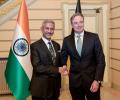
The era where nations thrived through rigid alignments is giving way to an age where the connective State defines power. For India, that era has arrived, points out Dr Nishakant Ojha.
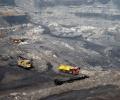
The 17 rare earth elements that are at the centre of the current crisis are critical components of everyday products -- from cars to jet engines to electronics like smartphones and flat-screen TVs.

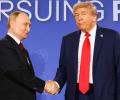
The US President reiterated his long-held view that Putin wants "ALL of Ukraine, not just a piece of it," and warned that such ambitions could lead to "the downfall of Russia."
'No respite from economic pain is worth the loss of dignity and self-respect,' asserts former foreign secretary Shyam Saran.
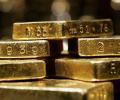
Gold, a safe-haven bet, is likely to continue its record-smashing journey in the New Year, rising to Rs 85,000 per 10 grams and even Rs 90,000 level in domestic markets if geopolitical tensions and global economic uncertainties continue.
